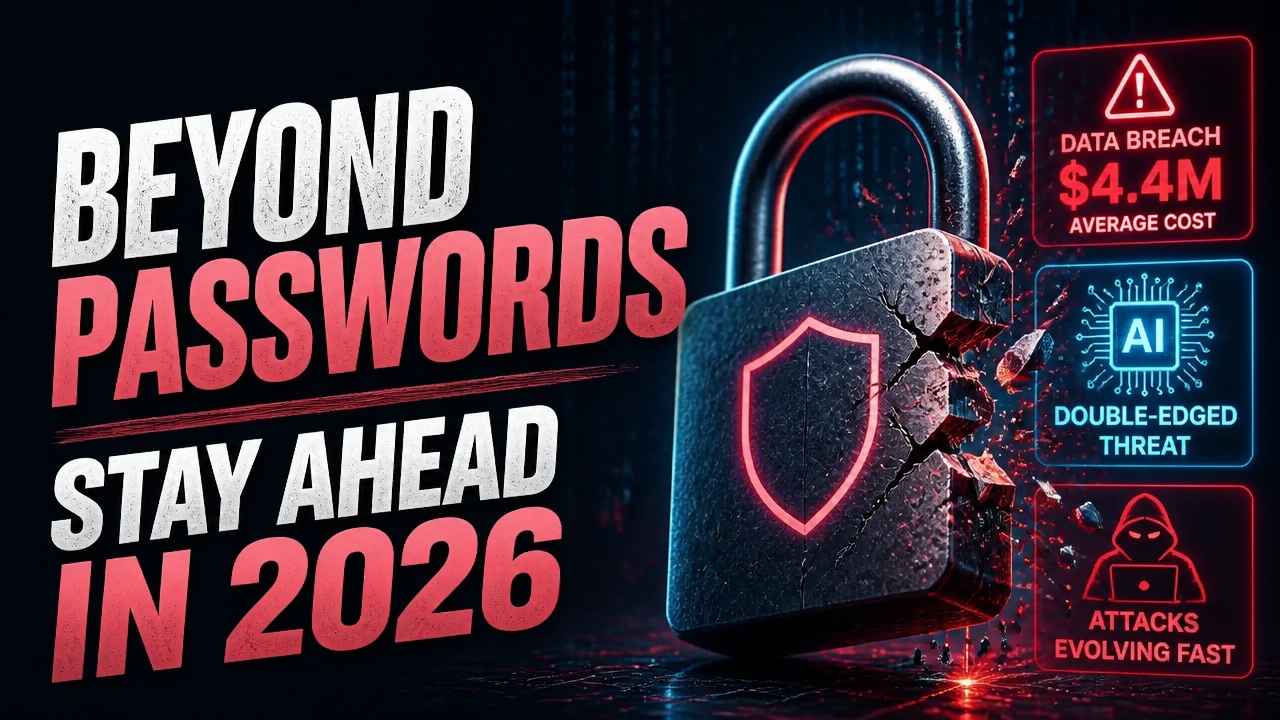
Cybersecurity 2026 for developers has moved far beyond the password manager and the phishing warning. The modern threat landscape includes software vulnerabilities, misconfigured cloud systems, ransomware, identity attacks, shadow AI, and autonomous AI agents that act at machine speed. If your mental model of security stops at “strong password and don’t click suspicious links,” this guide is your update.
🏙️ Your Company Is a City, Not a House
The classic image of cybersecurity is a house with a strong front door — good lock, good password, and you’re safe. The more accurate image in 2026 is a city with thousands of entry points: every web app, every API, every cloud service, every employee’s SaaS tool, every open-source library, and every AI agent running in the background.
Attackers don’t need to break through your strongest door. They only need to find one unlocked window. According to the Verizon Data Breach Investigations Report, 68% of breaches still involve a human element — a misused credential, a misconfiguration, or a social engineering mistake. The attack surface grew; so did the human factor inside it.
| Old model (2010) | New model (2026) |
|---|---|
| Strong password | MFA / passkeys |
| Antivirus software | Software vulnerability patching |
| Firewall | Cloud configuration review |
| Phishing training | Shadow AI policy |
| Suspicious email awareness | Agentic AI permission controls |
| — | Vendor and supply chain monitoring |
| — | Incident response practice |
💻 Software Vulnerabilities Are the New Front Door
One of the most important shifts tracked in recent breach data: vulnerability exploitation as an initial access vector nearly tripled year-over-year, per Verizon’s DBIR. Every application you build or depend on is a candidate for this. Your own code, third-party libraries, cloud infrastructure configurations, APIs, and vendor tools all contribute to the attack surface.
CISA maintains a public catalog of vulnerabilities being actively exploited right now — new entries appear every week. Patching critical vulnerabilities within 24 hours of disclosure is no longer a best practice; it is a deadline. Cybersecurity 2026 for developers means treating dependency updates and CVE monitoring as part of shipping software, not optional maintenance.
⚠️ Shadow AI: The Risk That Looks Like Productivity
Shadow AI refers to AI tools employees use without company approval — a personal account with a consumer chatbot, a browser-based writing assistant, an unapproved code reviewer. No malware is involved. No phishing link gets clicked. An employee pastes source code, customer data, or internal documents into a tool to save time. The data may leave company control silently, with no audit trail.
This is not a hypothetical. Internal surveys at large companies regularly surface usage rates of 30–60% for unapproved AI tools among employees. Clear rules about which AI tools are approved for work data prevent more incidents than technical controls alone.
🤖 Agentic AI: More Useful, More Dangerous
The distinction that matters: chatbots answer questions; agents take action. An AI agent with broad permissions can read your codebase, query live databases, send emails, call external APIs, and trigger deployments — all autonomously, all at machine speed. The OWASP LLM Top 10 identifies excessive agency and prompt injection as two of the most critical risks for teams building with large language models.
Prompt injection is particularly insidious: malicious instructions hidden in a webpage, email, or document that an agent reads can hijack that agent’s behavior without any technical breach. CISA is consistent on the safeguard: treat AI agents like privileged accounts, grant only the minimum permissions they need, and require human approval before any high-impact action.
📊 The Data Behind Modern Threats
The numbers from major annual reports clarify the scale:
- $4.4 million — average global data breach cost (IBM Security, 2025)
- 292 days — average time to identify and contain a credential-based breach (IBM)
- ~23% of all breaches involved ransomware (Verizon DBIR)
- 38 million identity risk detections per day processed across 100 trillion daily signals (Microsoft 2025)
- 99% of automated credential attacks blocked by MFA (Microsoft 2025)
- $2.2 million saved per breach by organizations with deployed AI security capabilities (IBM)
The MFA statistic is particularly striking: one change blocks nearly all automated credential stuffing. It is not optional infrastructure anymore.
🛡️ Practical Defensive Checklist for 2026
These five actions address the most common modern breach entry points:
- Patch critical vulnerabilities within 24 hours — monitor CVE feeds and automate dependency scanning
- Enable MFA or passkeys on every account — this single step blocks 99% of automated credential attacks
- Limit permissions for users and AI agents — apply least privilege; give agents only the tools they need for their specific task
- Never paste sensitive data into unapproved AI tools — establish a clear approved-tools list and train your team on it
- Keep backups and practice your incident response plan — ransomware is present in roughly 1-in-4 breaches; knowing what to do before it happens reduces damage significantly
Monitoring third-party tools and APIs regularly, reviewing vendor access rights, and creating explicit AI usage rules round out the full picture.
FAQ
What are the biggest cybersecurity threats in 2026?
The major threat categories in 2026 include software vulnerability exploitation (which nearly tripled as an initial access vector per Verizon DBIR), ransomware (present in ~23% of breaches), identity and credential attacks, shadow AI data exposure, agentic AI over-permission, and supply chain vulnerabilities through third-party libraries and vendors.
What is shadow AI and why is it a cybersecurity risk?
Shadow AI refers to AI tools employees use at work without company approval or IT oversight. The risk is data exposure: sensitive files, customer data, or proprietary code pasted into unapproved tools may be stored externally, used for model training, or subject to weaker privacy protections than enterprise-grade agreements. No hack is required for the data to leave company control.
Is a strong password still enough to stay secure?
No — though passwords still matter. Credentials are routinely stolen through phishing, infostealers, or data breaches of other services where passwords were reused. The password’s strength becomes irrelevant once it is exposed. MFA or passkeys add a second factor that stolen passwords cannot bypass, which is why Microsoft reports MFA blocks 99% of automated credential attacks.
What is the OWASP LLM Top 10?
The OWASP Top 10 for Large Language Model Applications is a community-maintained list of the most critical security risks for applications built on LLMs. The top risks include prompt injection, sensitive information disclosure, excessive agency, insecure plugins and tools, and supply chain vulnerabilities in AI components.
How do I secure AI agents at work?
Apply the principle of least privilege: give each agent only the specific tools and data access it needs for its task. Require human approval before any high-impact action such as sending emails, modifying production data, or triggering deployments. Review what your agents can touch regularly, and treat agentic AI systems with the same care you apply to any privileged user account.
How fast do attackers exploit published vulnerabilities?
The window has shortened dramatically. Automated scanning means working exploits can surface within hours of a CVE being published. CISA’s Known Exploited Vulnerabilities catalog adds new entries every week. For critical vulnerabilities, a 24-hour patch target is the current defensive standard.
✨ Key takeaways
- ⚡ Vulnerability exploitation nearly tripled as an initial access vector — patching is now a security deadline, not maintenance
- 🤖 AI agents that can read files, call APIs, and send emails need the same permission controls as any privileged account
- ⚠️ Shadow AI leaks data without any hack — a policy and approved-tools list prevents more incidents than technical controls alone
- 🔐 MFA blocks 99% of automated credential attacks — it is not optional infrastructure in 2026
- 📊 The average breach costs $4.4M and takes 292 days to detect when credentials are involved — speed of detection matters
- ✅ The safest organizations know what they own, patch what matters fast, and treat every connected system as part of their security surface
Cybersecurity 2026 for developers is about managing software, identity, cloud systems, and AI tools at the same time — and knowing what you own.