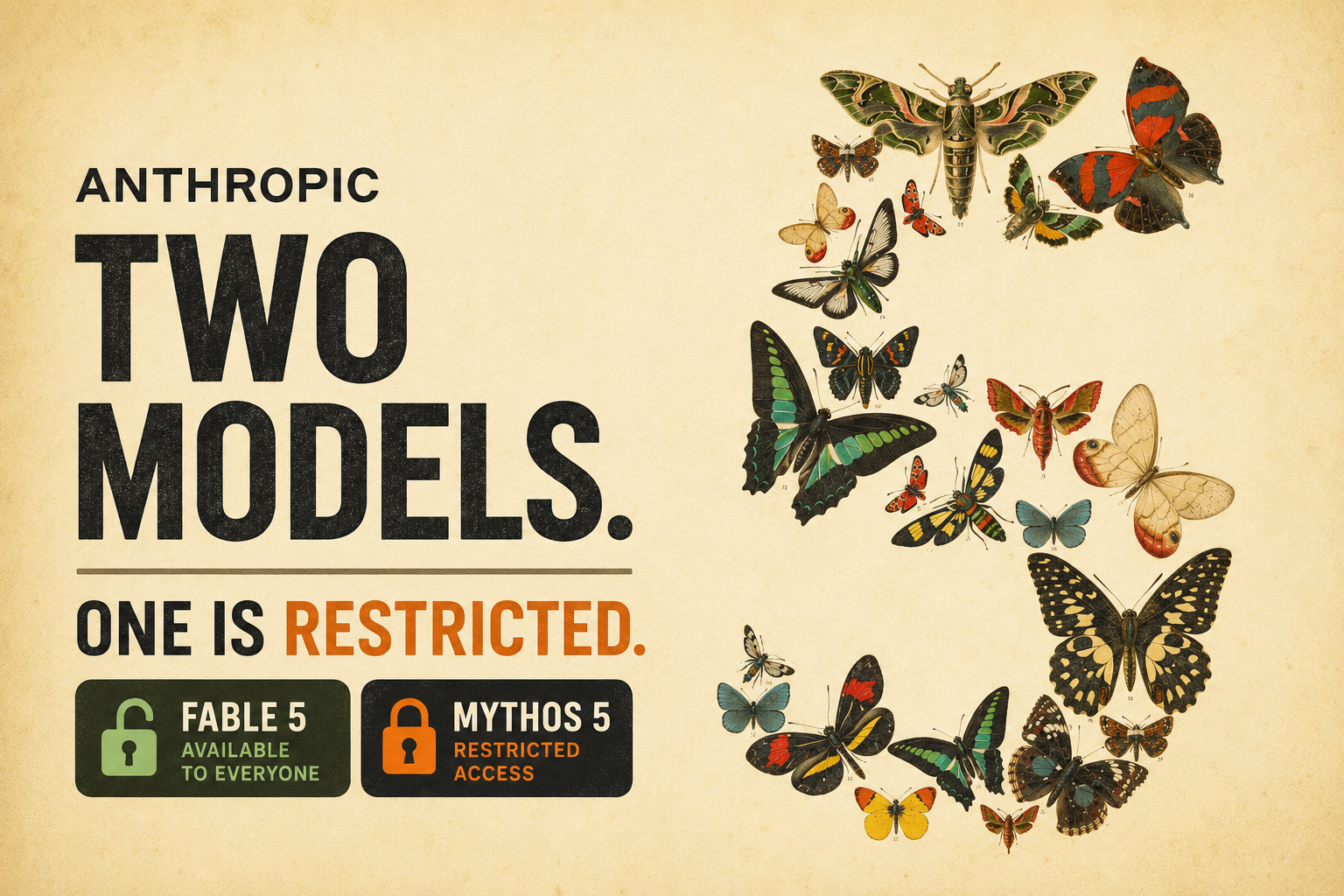
Claude Fable 5 and Mythos 5 share the same underlying architecture — but they represent two very different answers to the same question: who should have access to the most capable AI systems, and under what conditions?
🆚 Fable 5 vs Mythos 5 at a Glance
| Feature | Claude Fable 5 | Claude Mythos 5 |
|---|---|---|
| Public access | ✅ Standard API | ❌ Restricted |
| Safety classifiers | Active | Reduced |
| Cybersecurity capability | Limited | Full |
| Context window | 1M tokens | 1M tokens |
| Output limit | 128k tokens | 128k tokens |
| Access path | Anthropic API, Bedrock, Vertex, Foundry | Project Glasswing only |
| Pricing | $10 input / $50 output per 1M tokens | Glasswing partners |
Both models were announced on June 9, 2026. The split is intentional: same capability base, different access conditions.
🚀 What Claude Fable 5 Can Do
Claude Fable 5 is the most powerful model Anthropic has made publicly available. For software engineers and developers, the practical capabilities include multi-file code reasoning, debugging, refactoring, and long-running agentic task completion — including autonomous tool use across multiple steps.
The 1 million token context window is the most practically significant spec. That’s roughly 750,000 words — enough to hold an entire codebase, a long research corpus, or an extended agent conversation in a single context. The 128k output limit enables long-form generation without truncation.
In sensitive domains — cybersecurity, biology, chemistry, model extraction — Fable 5 routes requests through safety classifiers. Depending on the request, it either refuses or falls back to Claude Opus 4.8 rather than attempting the task with full Fable 5 capability.
🔒 What Makes Mythos 5 Different
Claude Mythos 5 starts from the same foundation as Fable 5. The distinction is what remains enabled. Cybersecurity capabilities that trigger classifiers in Fable 5 are active in Mythos 5 — which is precisely why access is controlled.
Access is managed through Project Glasswing, a formal enrollment process. Organizations apply, submit their use case, and undergo verification before receiving access. This is not a paid tier — it’s a trust tier based on verified intent.
The intended users are defenders: security research teams, vulnerability researchers, and selected institutional partners whose job requires understanding offensive techniques in order to build better defenses.
🛡️ Project Glasswing and the Defender Advantage
Project Glasswing is built around a specific asymmetry: attackers only need to find one exploit to succeed, while defenders must find every vulnerability. A model capable of large-scale vulnerability discovery changes that equation — if defenders get access first.
The Glasswing program is Anthropic’s answer to the question of what to do when your model is capable enough to be a serious offensive tool. Rather than suppressing the capability entirely, the program sequences access: vetted defenders get it under controlled conditions before equivalent capability becomes widely available.
⚙️ Safety Routing in Fable 5
Every request to Fable 5 passes through a classifier before the model responds. Standard domains — coding, writing, analysis — go directly to Fable 5. Requests touching high-risk areas route to a more conservative path.
According to Anthropic’s responsible scaling policy, high-risk domains include offensive cybersecurity operations, biological agent synthesis, chemical weapons, and model extraction attempts. In these cases, Fable 5 either returns a refusal or falls back to Opus 4.8 — preserving utility for legitimate edge cases while containing misuse risk.
The acceptable use policy is where the hard lines are drawn. Violations can result in losing API access entirely, not just a model refusal.
💰 Pricing and Availability
Fable 5 is priced at $10 per million input tokens and $50 per million output tokens. For cost estimation purposes, the output side dominates: a 100,000-token response costs $5 in output alone. Long-form generation tasks should be budgeted from the output side.
The model is available through:
– Anthropic direct API (claude-fable-5)
– Amazon Bedrock
– Google Vertex AI
– Microsoft Foundry
Cloud availability can lag the direct API release by a few days — check platform documentation before assuming parity on launch day.
📊 Why the Dual Release Matters
Earlier Claude families introduced capability tiers — Opus for power, Sonnet for balance, Haiku for speed. The Claude Fable 5 Mythos 5 release is structurally different. This is not a capability tier. It’s a trust tier: same underlying capability, different access conditions based on verified organizational intent rather than pricing.
If this pattern proves workable, it has implications beyond Anthropic. The dual-track model — powerful public release with safeguards, restricted release for vetted partners — is already being discussed by third-party observers as a potential template for how other frontier labs might handle increasingly capable systems.
For the Anthropic dual model release to hold up over time, the vetting process has to scale and the safety classifiers have to keep pace with capability growth. Whether those conditions hold is an open question. But the architecture of the release itself is a concrete implementation of tiered access — an idea that has been discussed theoretically in AI safety circles for years.
FAQ
What is the difference between Claude Fable 5 and Claude Mythos 5?
Claude Fable 5 and Mythos 5 share the same underlying model architecture. The difference is access and guardrails. Fable 5 is publicly available through the standard API with safety classifiers active. Mythos 5 is available only to trusted organizations through Project Glasswing and has fewer active restrictions, particularly in cybersecurity domains.
What is Project Glasswing and how do you get access?
Project Glasswing is Anthropic’s controlled-access program for Claude Mythos 5. Organizations apply by submitting their use case and undergo a formal vetting process. Access is granted based on verified organizational intent — primarily security researchers, vulnerability researchers, and selected institutional partners. It is not a paid tier.
Is Claude Mythos 5 available to the public?
No. Claude Mythos 5 is not available through the standard Anthropic API, Amazon Bedrock, Google Vertex, or Microsoft Foundry. Access is exclusively through Project Glasswing after organizational vetting.
How much does Claude Fable 5 cost per million tokens?
Claude Fable 5 is priced at $10 per million input tokens and $50 per million output tokens. For workloads involving long-form generation, the output cost dominates — a 100,000-token response costs approximately $5 in output alone.
Why did Anthropic fall back to Opus 4.8 instead of refusing sensitive requests?
The fallback-to-Opus-4.8 approach preserves utility for legitimate edge cases in sensitive domains rather than issuing hard refusals across the board. Opus 4.8 is a capable model with more conservative safety behavior — requests that trigger Fable 5’s classifiers are handled there rather than rejected outright.
What platforms support Claude Fable 5?
Claude Fable 5 is available through the Anthropic direct API, Amazon Bedrock, Google Vertex AI, and Microsoft Foundry. Cloud platform availability may lag the direct API release by a few days around launch.
✨ Key Takeaways
- ✅ Claude Fable 5 and Mythos 5 share the same model architecture — the difference is guardrails and access conditions
- 🔒 Mythos 5 is accessible only through Project Glasswing, a formal organizational vetting process — not a pricing tier
- ⚡ Fable 5 supports a 1 million token context window and up to 128k output tokens, optimized for agentic coding workflows
- 🛡️ High-risk domains (cybersecurity, biology, chemistry) route to Opus 4.8 fallback rather than hard refusals
- 📊 Pricing is $10 per million input tokens and $50 per million output tokens — budget from the output side for generation tasks
- 🚀 The dual-track release is the first explicit trust tier from a major frontier lab — same capability, different access based on verified intent
Check the official Anthropic models overview for API identifiers, context limits, and the latest release notes before you ship.